

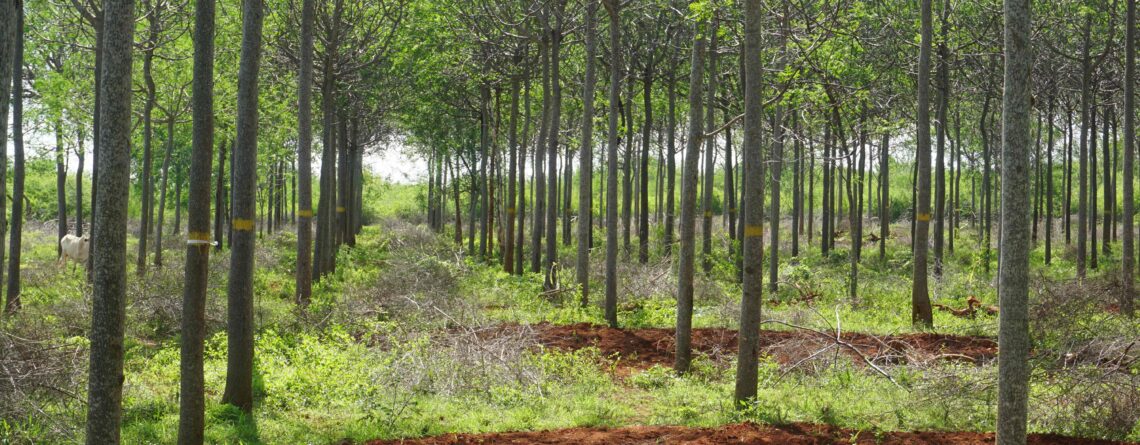
Most of Treevive’s work starts at a desk: feasibility studies, project documents, financial models. Crucial work, but only part of the picture. A visit to the field can add context, sharpen assumptions and help translate theory into something tangible. Last November, Christiaan Spencer travelled to Kenya to visit a potential forest landscape restoration project in a semi-arid region. The goal was to explore the project’s feasibility and further shape the business plan.
“Standing on the ground and using all your senses you begin to understand the local reality, the implications of key assumptions and reality and potential impacts of reforestation projects.”
Driving through the landscape, he witnessed the impact of decades of deforestation and ongoing drivers principally, charcoal production, which has transformed the landscape to its current degraded state.
“You suddenly witness the driver of deforestation and start to understand its impact on the landscape. As we drove through the landscape, we saw bags of charcoal along the road and loaded on scooters in an area where the land was almost completely stripped of trees.”
On the project site and surrounding farms, the team walked through young plantations, nurseries and trial plots with native, drought-tolerant species. Discussions with local staff and stakeholders quickly became very concrete: planting densities, thinning, pruning, water limitations and what it takes to grow a commercially valuable tree in a semi-arid climate.
Bringing field insights back into Treevive’s work
Back at his desk, Christiaan finds that the visit simply helps him read project information with different eyes. “Seeing the context once makes it easier to judge what is realistic and what isn’t.” For Treevive, experiences like this can add real value:
• They provide context to test assumptions during early feasibility work.
• They help link forestry practice and carbon modelling to the realities of the landscape.
• They highlight what local farmers and stakeholders actually need and want.
• They give team members who work mainly from documents a deeper, more intuitive understanding of project dynamics.
“Being in the field brings you back to the essence of what we do. It’s not just about tonnes of CO₂ or hectares on a slide, it’s about real landscapes, real people and long-term change that needs to work for everyone involved.” – Christiaan Spencer, 2025