

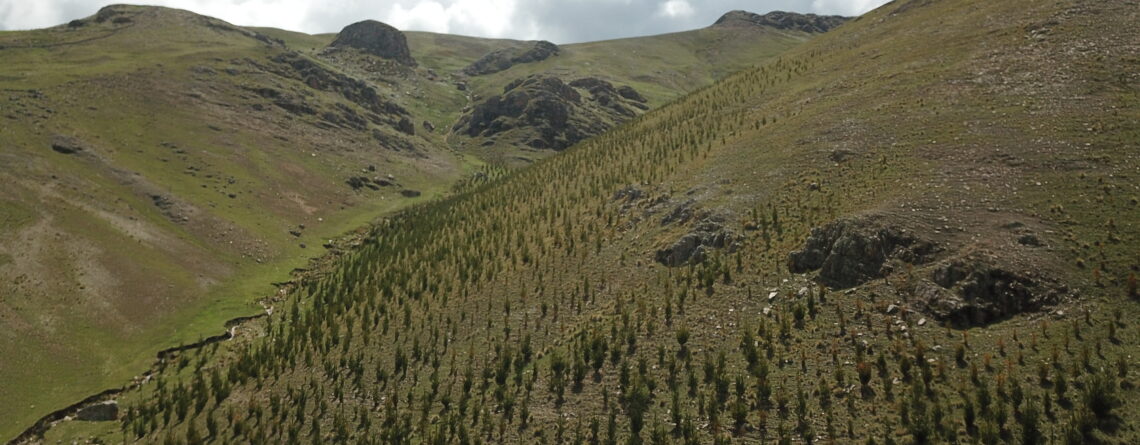
The Más Árboles project in Cusco, Peru, continues to progress toward large-scale landscape restoration, supported by strong community participation and solid technical preparation for the new planting season. The next forest campaign is planned to start in mid-December, aligned with the onset of the rains. District coordinators are currently holding community meetings, answering questions, validating planting areas, and preparing the fieldwork without interfering with agricultural activities. Planting will begin with tracing, marking, and digging in designated areas. During these activities, communities will also define water-monitoring points, a key element for long-term ecosystem management.
2025 planting campaign
With around 2 million seedlings across 11 active nurseries, the project plans to restore approximately 3,000 hectares during the next planting campaign. A new nursery is being established in Paccaritambo, with a projected capacity of over 400,000 seedlings. This expansion is supported by Fundación Greer and integrates the Pachamama Raymi methodology: reforestation, preventive health measures and family well-being, cultural identity strengthening, and the development of sustainable family enterprises.
Strong community engagement
Community involvement remains high, with 4,100+ families directly engaged. Between July and September, over 70 community assemblies were held to strengthen dialogue and gather input from women, youth and vulnerable groups. In communal nurseries, members are actively employed in sowing, weeding, bed preparation, and maintenance. All remunerated work. For 2025, the project prioritises capacity-building in:
- Forest area management
- Plantation maintenance
- Risk prevention (fires, grazing)
- Community organisation and management
Complementary productive activities — such as mushroom harvesting, dehydration, and commercialisation — are being scaled up.
Recent milestones include:
- Completion of the Free, Prior and Informed Consent (FPIC) process
- Signing of community cooperation agreements
- Installation of firebreaks in high-risk areas
- Joint training with the Cusco Regional Government on wildfire prevention and response
- Forest plantation assessments
Monitoring ecosystem restoration
Soil samples have also been collected across all forested areas and control plots. Results expected in November will help measure improvements in soil quality — organic matter, pH, moisture retention, nutrients — and inform future restoration design.
Key lessons learned
Across recent campaigns, several improvements have strengthened the project:
- Improved nursery management, including substrate disinfection, root pruning, and permanent weeding, has increased plant quality
- Participatory planning has increased community ownership
- Continuous training has reinforced local technical capacity and trust
- Strong coordination with local governments and community councils has improved risk management and field execution
——
Interested in investing in this high impact, community driven project?
Contact us: info@treevive.earth